 Clamping & Workholding
 Measuring & Layout
 Storage & Organization
 Caulking & Sealing
 Jigs & Guides
 Work Supports & Stands


 Home
For OEM buyers, two clamps with similar dimensions, comparable appearances and nearly identical advertised maximum clamping forces may deliver very different results in actual use.
These differences extend beyond maximum force. They include force retention, ease of operation, material performance, heat treatment, manufacturing precision and long-term durability.
Clamping force is one of the most important performance indicators of a clamp. However, advertised maximum force alone does not provide a complete picture of product quality. Three measurements deserve particular attention.
Maximum Clamping Force: The highest force a clamp can generate under specified test conditions. It indicates the upper limit of the product's capability, but does not necessarily represent the force a user can comfortably and repeatedly achieve during normal operation.
Initial Clamping Force: The actual force applied to the workpiece immediately after normal tightening is completed and the operator's input is removed. This measurement helps reveal how effectively a clamp converts the user's effort into useful clamping force.
Stable Clamping Force: The force remaining after a specified holding period under controlled test conditions. In many woodworking and assembly applications, a clamp must maintain pressure for an extended period. A high initial force is valuable, but the ability to retain that force is equally important. Two clamps with similar advertised maximum forces may exhibit significantly different force-retention behavior. The differences can result from structural engineering, material deformation, locking-system stability, thread performance and manufacturing tolerances.
Maximum clamping force receives considerable attention in product specifications. Yet another performance characteristic has a direct impact on user experience: How much effort does the user need to apply to achieve the required clamping force?
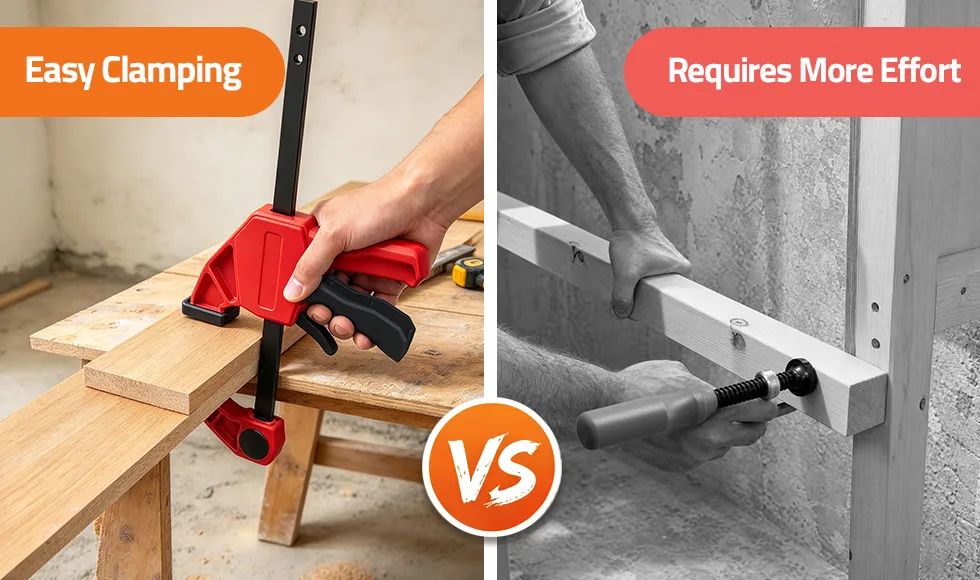
We propose evaluating this characteristic through a concept called Clamping Efficiency. Clamping efficiency describes how easily a clamp reaches the required clamping force. A high-efficiency clamp delivers sufficient force with less operating effort, while a low-efficiency clamp may require considerable effort yet still fail to achieve the desired force.
It is a proposed procurement evaluation concept rather than an established industry standard. Consider two clamps with similar advertised maximum forces. One features an efficient transmission mechanism, smooth operation and reliable locking. The user can reach the required force with moderate effort. The other may require repeated trigger strokes or substantial handle torque, yet still struggle to generate the desired force. Possible causes include transmission losses, excessive friction, structural deformation, inefficient locking geometry and poor manufacturing precision.
For OEM buyers and private-label brands, a clamp is more than a functional tool. It is also part of a brand's product identity. In a market where many products share similar dimensions and basic mechanisms, distinctive industrial design offers an opportunity for differentiation.
Good clamp design combines visual appeal with practical functionality. Product proportions, clean lines and a consistent visual language contribute to a professional appearance. The design of the jaws, sliding arms, handles and locking mechanisms should also support usability rather than simply create a different look.
Attention to detail is equally important. Consistent surface finishes, carefully selected material textures, coordinated colors and controlled assembly gaps contribute to the overall perception of product quality.
For OEM brands, design consistency across product categories creates additional value. Industrial design should therefore be considered an integral part of product development, not merely a cosmetic addition.
Material selection plays a fundamental role in a clamp's strength, durability and operating stability. Two visually similar products may use very different materials in their load-bearing components. These differences can influence deformation resistance, wear performance and service life.
4.1 Malleable Iron vs. Ductile Iron
Malleable cast iron and ductile cast iron are both established engineering materials. However, their microstructures, manufacturing processes and available mechanical properties differ. Appropriately selected ductile iron grades can be particularly valuable for clamp components subjected to substantial loading and repeated operation.
In high-performance parallel clamps and F-clamps, suitable ductile iron grades can provide a useful combination of strength and toughness for structural arms.
The clamping arm is a particularly important component because it must carry clamping loads while maintaining positional stability.
4.2 Ordinary Carbon Steel vs. High-Strength Carbon Steels
Steel bars, spindles and other load-bearing components are essential to clamp performance. Cost-driven products may use lower-strength ordinary carbon steels or steel components without sufficient strengthening treatment. Depending on the design, this can increase the risk of permanent deformation, localized wear and deterioration of locking performance.
High-strength carbon steels offer additional options for achieving the required combination of strength, hardness and toughness. When matched with suitable heat treatment, these materials can provide improved performance in demanding applications.
Consider the steel bar of a clamp. It must withstand bending loads while also resisting repeated contact stresses in areas where the sliding arm locks against the bar. Material grade, cross-sectional geometry and heat treatment must therefore be considered together. The carbon content, alloy composition and prior heat-treatment condition also affect how a steel responds to induction hardening.
Selecting the right steel is only the beginning. The heat-treatment process can have a major influence on the final performance of a steel component.
Clamp bars and locking mechanisms experience repeated contact, sliding and localized stress. If the contact surfaces lack sufficient hardness, repeated use may cause wear, indentation or localized plastic deformation. These changes can gradually affect the geometry and reliability of the locking interface. Proper induction hardening can increase surface hardness and wear resistance in the treated areas.
The contact geometry between a clamp bar and its locking mechanism is essential to reliable operation. As these surfaces wear, their ability to maintain consistent engagement may deteriorate. Appropriate surface hardening can reduce the risk of wear-related changes and help maintain the functional integrity of the locking interface over repeated use.
Premium materials and advanced design are valuable only when supported by reliable manufacturing.
A clamp is a mechanical system composed of interacting components. Small dimensional deviations in critical parts can affect the performance of the entire assembly. A product with inadequate manufacturing precision may initially produce acceptable clamping force but deteriorate noticeably after repeated operation.
For OEM buyers, a successful prototype or a small number of excellent samples is not sufficient evidence of manufacturing capability. The more important consideration is whether the supplier can consistently reproduce the approved performance during volume production.